
12 March 2026
Two weeks into the Iran-Israel-US conflict, Middle East business aviation is showing tentative signs of stabilization. The acute shock of Week 9 has not deepened further, with departures partially recovering and grounded aircraft slowly clearing from regional airports. Commercial aviation tells a starker story, with scheduled airline departures remaining significantly below prior-year levels with no recovery trajectory visible across the week. Turkey has emerged as the dominant repositioning hub for displaced traffic. Oil prices, however, remain severely elevated across all major benchmarks with no meaningful recovery in sight, a cost headwind that extends well beyond the conflict zone. Globally, the broader bizjet market is absorbing the disruption with resilience, though the drag from the Middle East and Africa is measurable.
Middle East Bizjet Departures: Week 9 and 10 2026 vs Last Year
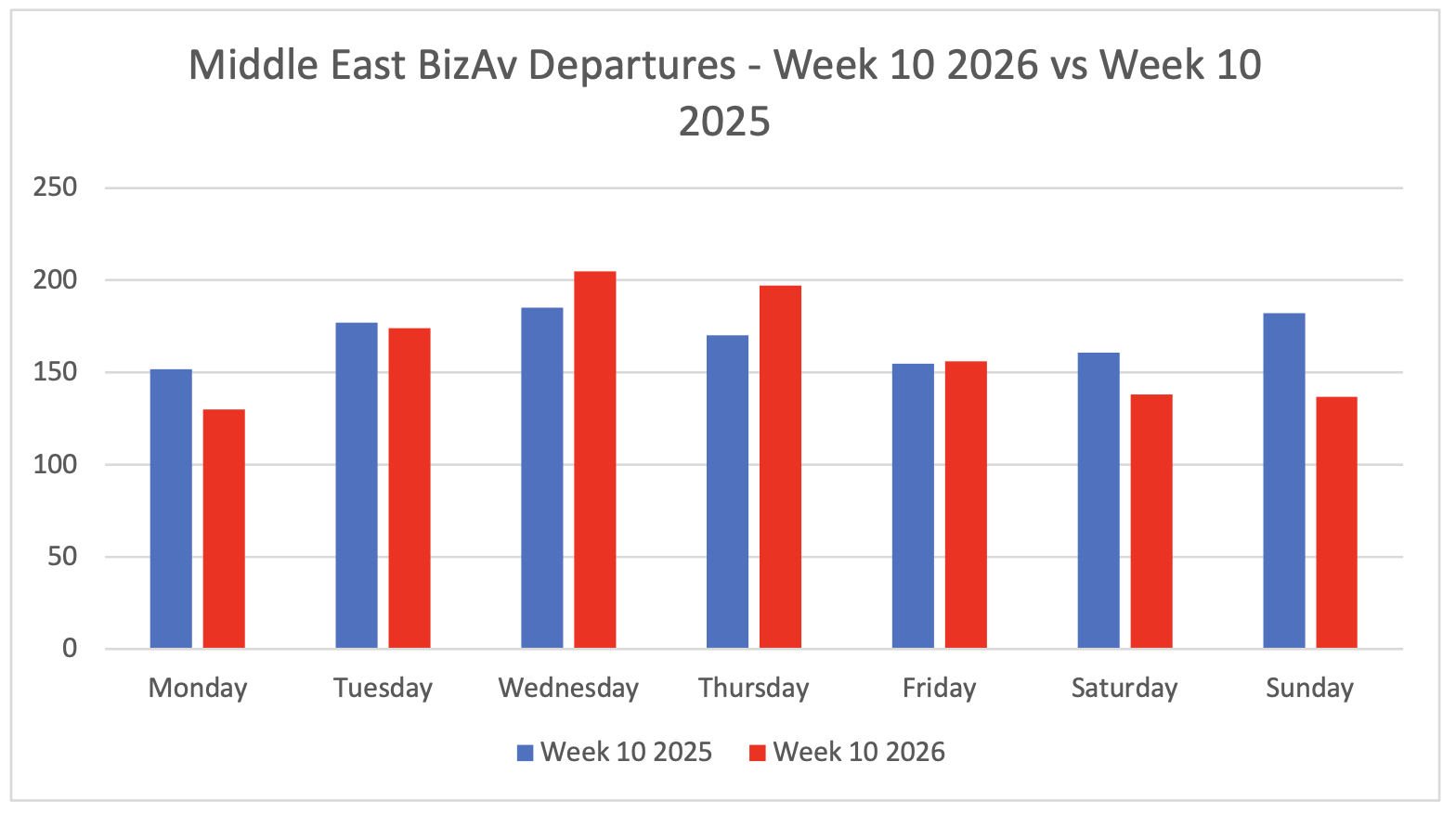
Charts 1 and 2 below compare the Middle East business jet departures day-by-day for Week 9 and 10 2026 against the equivalent weeks in 2025, providing the clearest measure of the conflict’s immediate impact on regional bizjet traffic.
As seen in our report last week, Week 9’s picture was stark, with departures throughout the entire week tracking meaningfully below 2025 levels, before collapsing further from Saturday 28th February, the day of the conflict outbreak, producing an overall Week 9 2026 vs Week 9 2025 decline of 29%.
Week 10 2026 (2 – 8 March) tells a more nuanced story. The 29% freefall realized in Week 9 did not deepen further, instead, departures partially stabilized, with Week 10 2026 running -4% vs Week 10 2025. Day-by-day, the two years in Week 10 track each other far more closely than in Week 9, with no single day showing a dramatic outlier. This suggests the initial shock-driven grounding of aircraft has passed its initial phase, and operators are cautiously resuming activity, though at levels still modestly below prior-year norms. The question for Week 11 is whether this stabilization holds or whether a sustained conflict environment drives a second leg down.
Chart 1: Daily Middle East business jet departures Week 9 2026 vs Week 9 2025
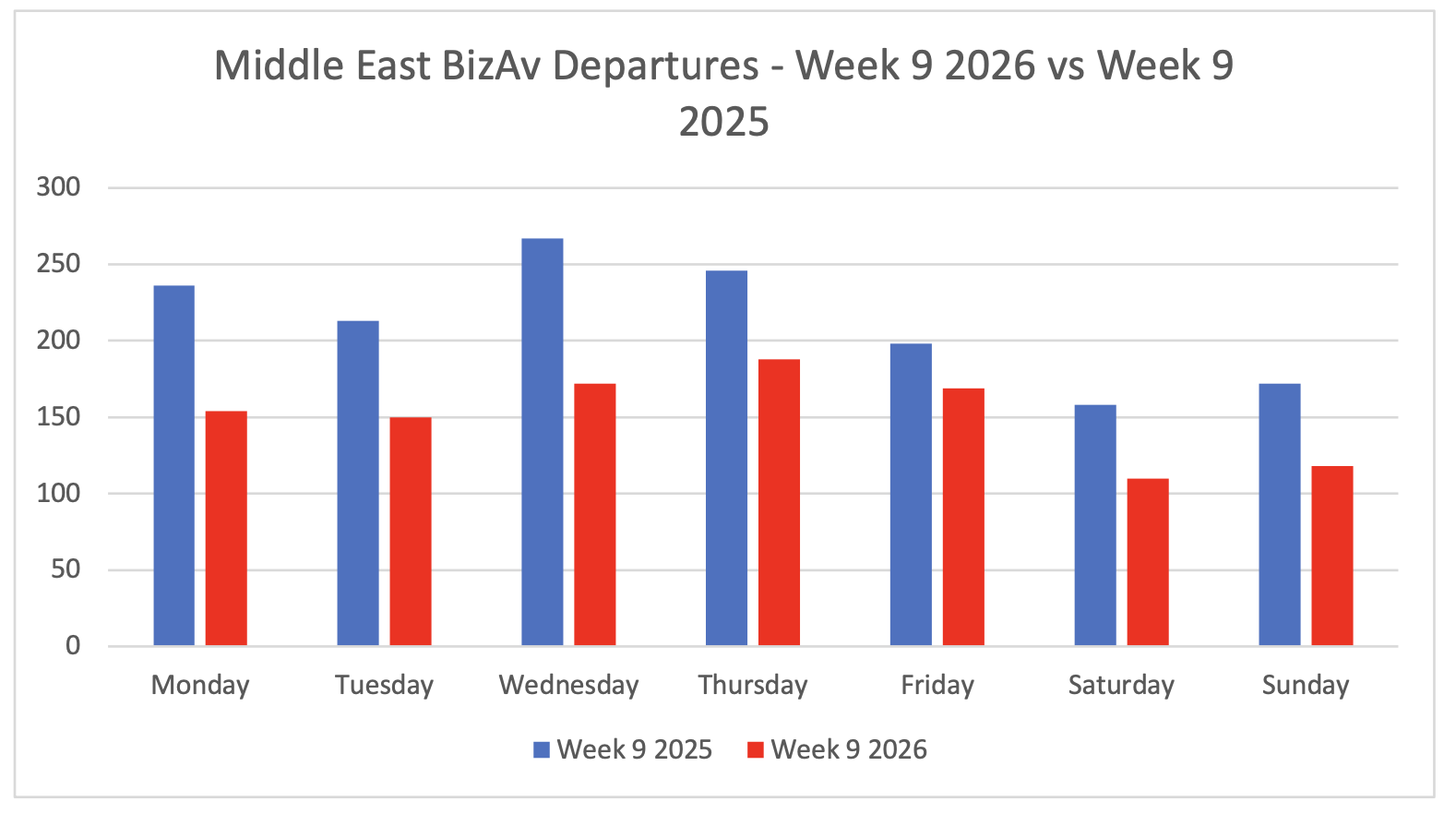
Chart 2: Daily Middle East business jet departures Week 10 2026 vs Week 10 2025
Where Did the Jets Go? Top Destinations 27 February – 8 March
Across the full 27 February – 8 March window, more than 1,500 business jet flights departed Middle East airports. Turkey dominated arriving traffic, absorbing 410 flights and 26.7% of all departures, cementing Istanbul’s role as the primary repositioning holding hub for the region. Greece followed with 95 flights (6.2%), while Oman (92 flights, 6.0%), France (74 flights, 4.8%), Saudi Arabia (74 flights, 4.8%), and Egypt (74 flights, 4.8%) rounded out the top destinations.
Chart 3: Middle East business jet departures by arrival country (27 February – 8 March)
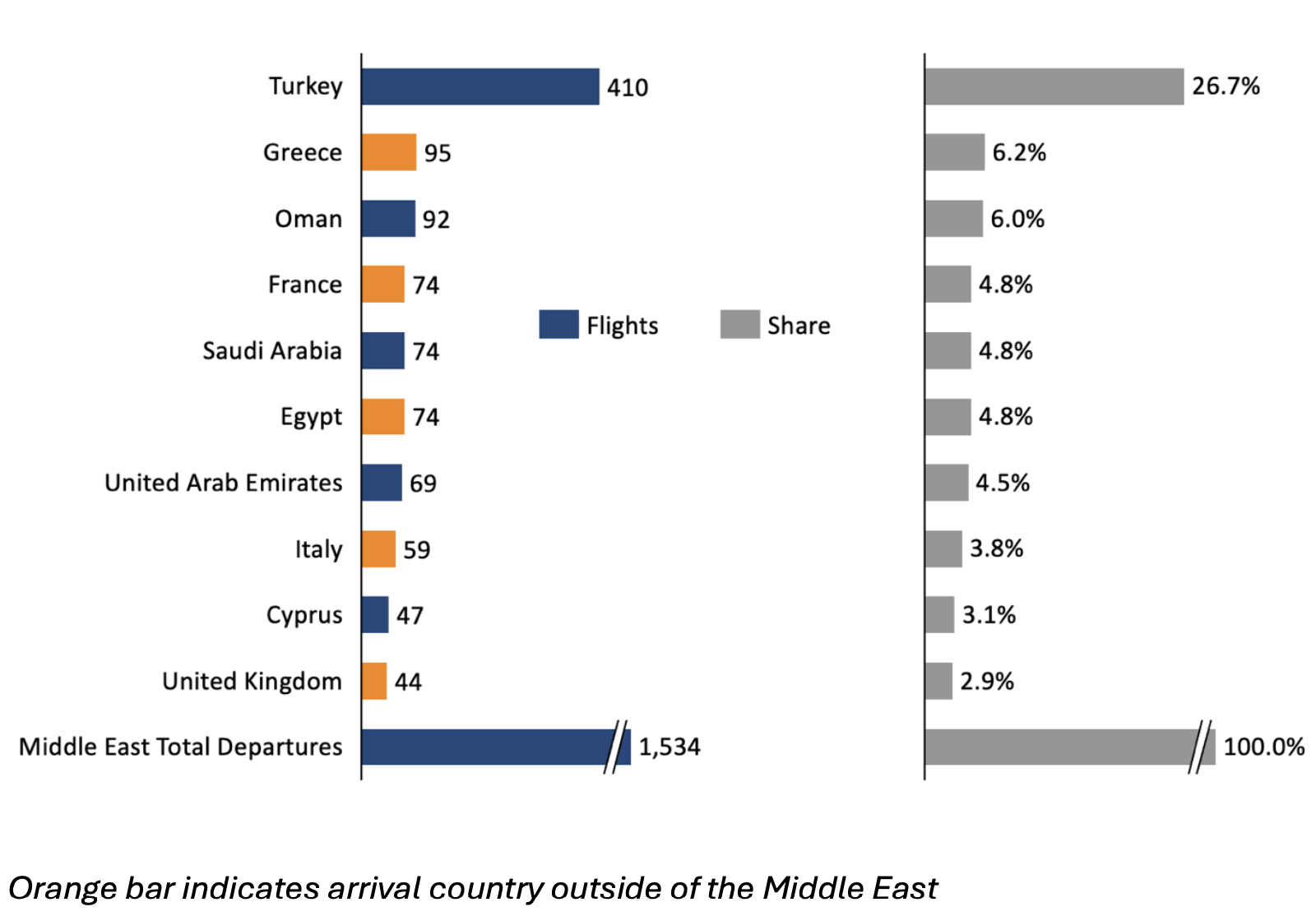
At a regional level 49% of all Middle East departures during this period remained within the Middle East itself, reflecting a combination of intra-regional repositioning and operators making short hops to non-conflict Gulf states. Europe was the dominant external destination drawing 35% of outbound traffic.
Parked Business Jets Across the Middle East Have Halved Since Outbreak of Conflict
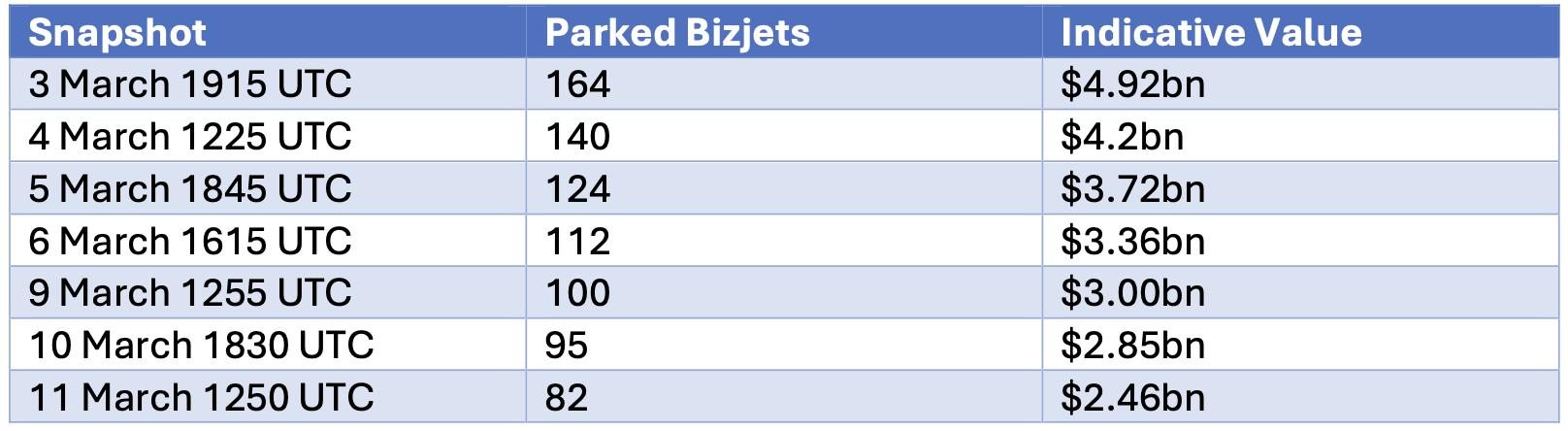
Of the business jets that departed the Middle East following the conflict outbreak, a significant portion repositioned to airports outside of the region, and WINGX parking data shows the decline of parked business jets in the Middle East. Since 28 February, the number of these grounded aircraft has declined steadily, falling from a peak of 164 recorded on 3 March 1915 UTC, representing an indicative fleet value of $4.92bn, to 82 aircraft by 11 March 1250 UTC, with an indicative value of $2.46bn still grounded in conflict-affected airports.
Chart 4: Middle East parked business jets snapshot (indicative value based on WINGX estimates)
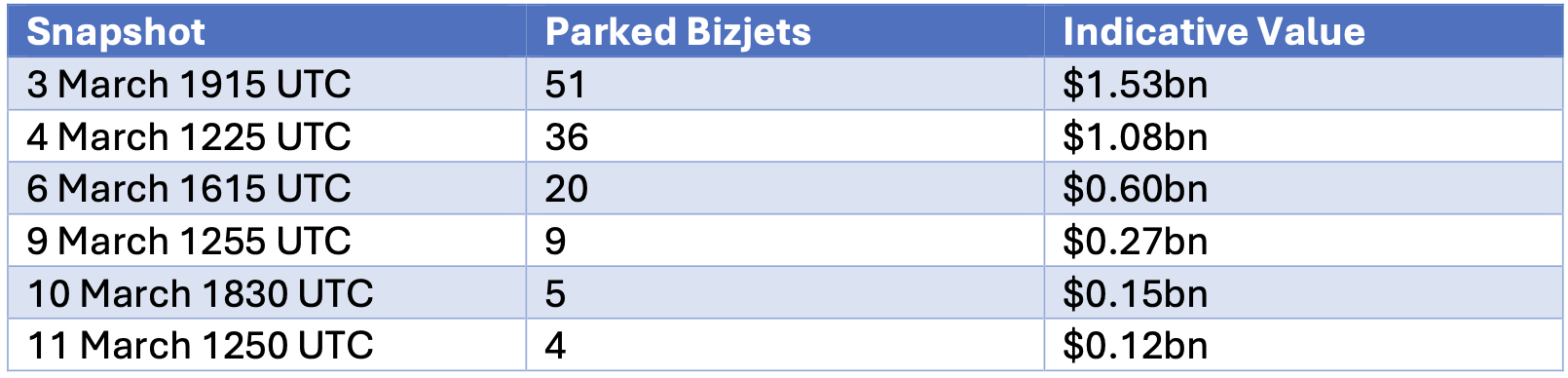
On a hub-city level, Dubai has shown one of the sharpest drops in the region. Parked bizjets at Dubai airports fell from 51 on 3 March to just 4 by 11 March, a 90% clearance rate.
Chart 5: Dubai parked business jets snapshot (indicative value based on WINGX estimates)
Oil Prices Surge Across All Markets in Wake of Conflict
The Iran-Israel-US conflict triggered an immediate and severe shock to oil prices globally, with Platts benchmark data showing prices surging across every major market within 72 hours of the outbreak on 28 February. FOB Arab Gulf Cargo, the benchmark most directly exposed to the conflict geography, led the spike, peaking at over 150%above pre-conflict levels by 4 March before partially retreating. European benchmarks including CIF NWE Cargo and FOB Rotterdam Barge, and US benchmarks New York Harbor Barge and USGC Waterborne, all peaked at between 50 – 85% above pre-conflict levels by 5 – 6 March and remained near those highs through 9 March with no sign of meaningful recovery.
For aviation, the implications are direct. Jet fuel costs track oil benchmark movements closely, and depending on the year, make, and model of aircraft, fuel can account for more than 50% of business jet direct hourly operating costs. Operators fueling across the Middle East, Europe, and North America are all facing a materially higher cost environment that shows no sign of abating while the conflict persists.
Scheduled Airlines Departures Remain Severely Depressed in Week 10
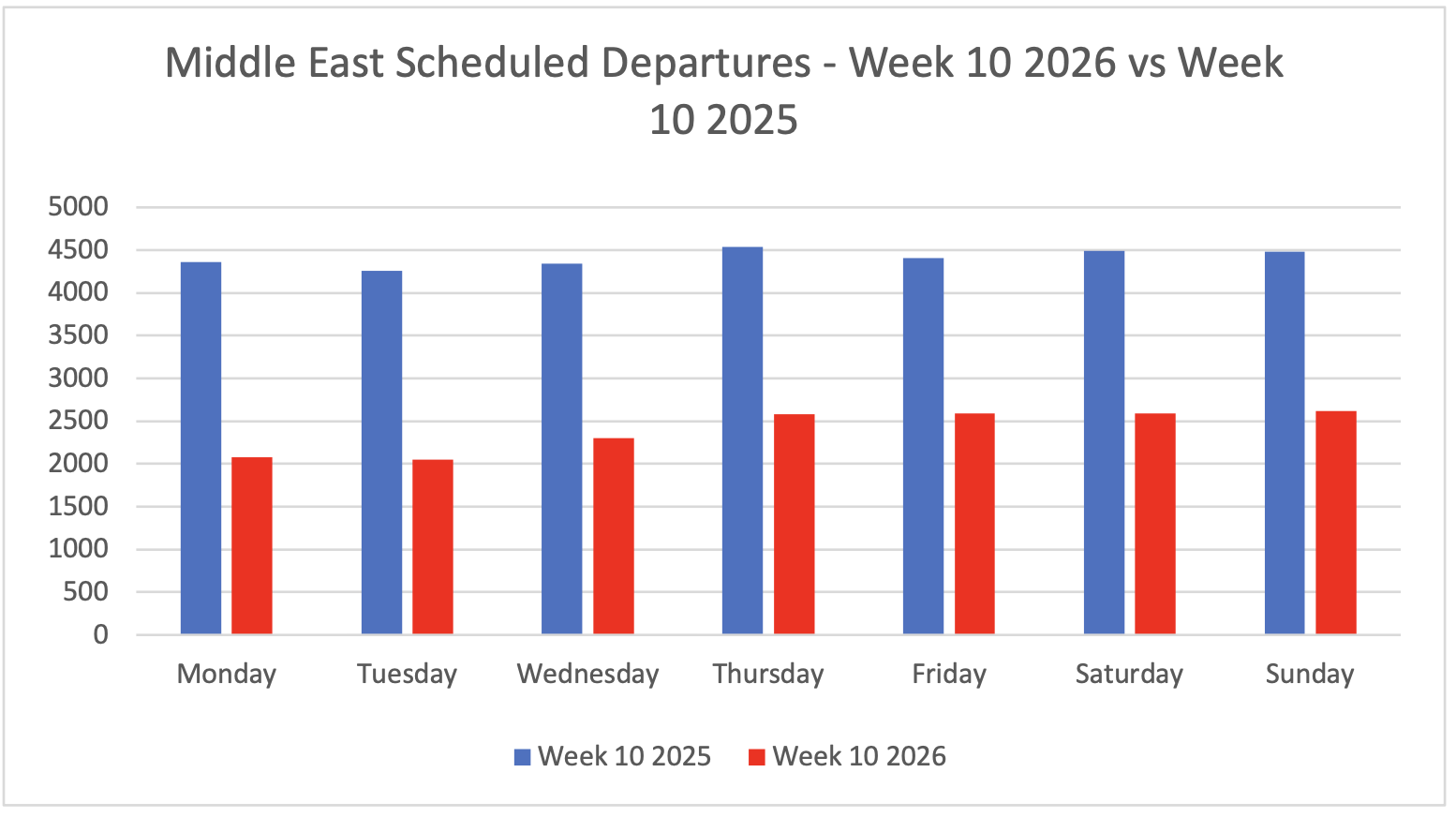
Middle East scheduled airline departures totaled over 16,800 in Week 10 2026, against more than 30,800 in the equivalent week last year, a 46% year-on-year decline that confirms commercial aviation remains deeply disrupted well into the conflict's second week. The day-by-day picture in the chart is striking: 2025 daily departures were broadly consistent across the week averaging around 4400 flights per day, while 2026 volumes held a much lower daily average of around 2400. Notably, the week shows no recovery trajectory, Sunday's departure count was virtually identical to Monday's, suggesting no meaningful resumption of normal scheduling had occurred by the end of Week 10.
Chart 6: Daily Middle East scheduled airline departures Week 10 2026 vs Week 10 2025
Global Bizjet Activity: How Much is the Middle East Dragging on Global Traffic?
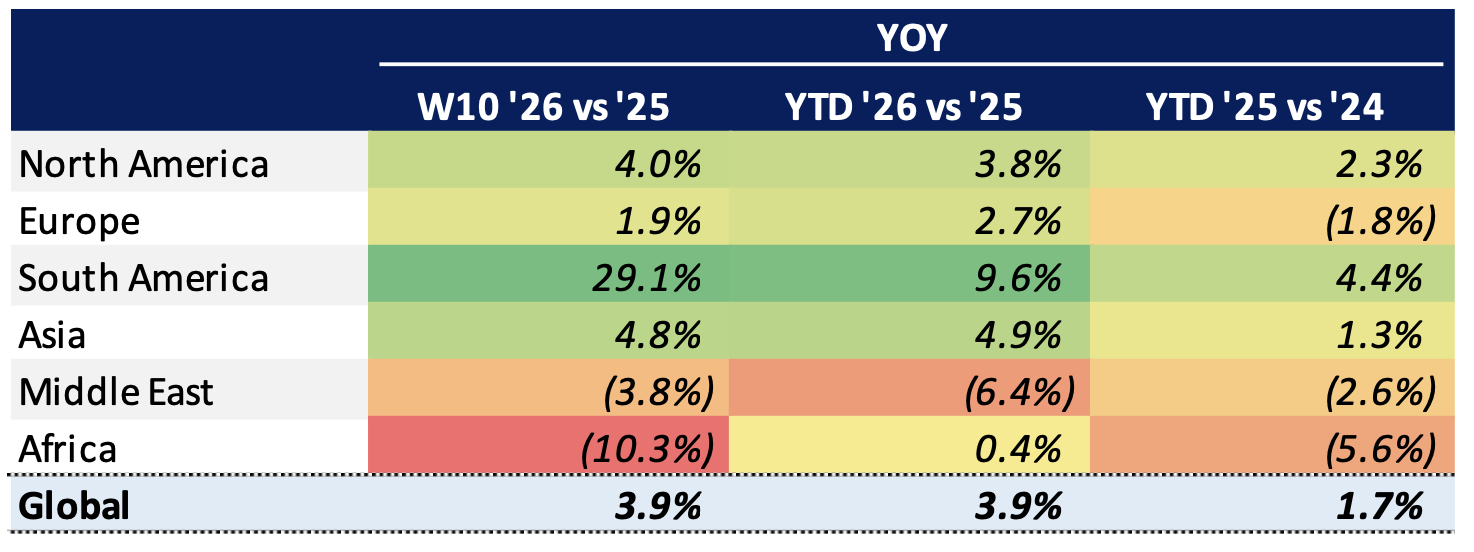
With Middle East and Africa bizjet traffic accounting for approximately 2% and 1% of global activity respectively, it is possible to quantify the combined drag on the global number. The Middle East's -3.8% Week 10 performance suppressed global growth by roughly 0.1 percentage points, while Africa's -10.3% decline contributed an additional 0.1 percentage points of drag, a combined 0.2 percentage point headwind on the global weekly figure. Put another way, global bizjet growth would be running closer to 4.1% in Week 10 rather than 3.9% were it not for the conflict's footprint across both regions.
The broader picture remains resilient. Global bizjet activity reached +3.9% YOY in Week 10, sitting at +3.9% year-to-date, a notable acceleration from the +1.7% growth rate achieved over the same period in 2025 vs 2024. North America continues to anchor global growth at +4.0% in Week 10 and +3.8% YTD, while South America remains the standout emerging market at +29.1% in Week 10 and +9.6% YTD. For now, the breadth of growth elsewhere is comfortably absorbing the combined Middle East and Africa drag, but a prolonged conflict would increasingly test that resilience.
Chart 7: Global Bizjet Departures Trends YTD (1 January – 8 March)
Nick Koscinski, WINGX Analyst, comments: "Two weeks in, the global flight data is telling a story of shock absorption rather than escalation. The step-down from Week 9's 29% collapse to Week 10's 4% decline is significant, it tells us the acute phase of the disruption has passed, even if full recovery remains a long way off. However, the scheduled airlines picture remains deeply disrupted and oil prices show no sign of retreating. The conflict's footprint on global bizjet traffic is measurable but contained for now. The next test will come in Week 11, whether we see any sort of recovery begin, or whether the market settles into a prolonged new normal of suppressed regional activity and elevated fuel costs."
Continue reading free
Enter your email to unlock this article and get the WINGX Bulletin delivered to your inbox, weekly.
